About Machine Learning ( Part 6: KNN vs. K-means )

In machine learning, K-Nearest Neighbors (KNN) and K-means Clustering are two commonly used algorithms. Despite their similar names, they serve different purposes and have distinct working principles.

KNN (K-Nearest Neighbors)

KNN is a supervised learning algorithm used for classification and regression tasks.

The core idea of KNN is:

Given a new data point, find the K most similar instances in the training dataset (neighbors) and use them to predict the output.

KNN is a lazy learning algorithm, meaning it does not require a training phase. Instead, it directly classifies or predicts based on stored data.
Read more

About Machine Learning ( Part 5: Support Vector Machine )

Support Vector Machine (SVM)

Support Vector Machines (SVM) are one of the most powerful supervised learning algorithms used for classification and regression tasks.

The Hyperplane

In a binary classification problem, the goal of SVM is to find a hyperplane that best separates two classes. Given a training dataset:

$$
D = { (\mathbf{x}_1, y_1), (\mathbf{x}_2, y_2), \dots, (\mathbf{x}_n, y_n) }, \quad \mathbf{x}_i \in \mathbb{R}^d, \quad y_i \in {-1, +1}
$$

  • $\mathbf{x}_i$: $d$-dimensional feature vector (e.g., pixel values in an image).
  • $y_i$: Class label ($+1$ for “cat”, $-1$ for “dog”).
Read more

About Machine Learning ( Part 4: Decision Tree )

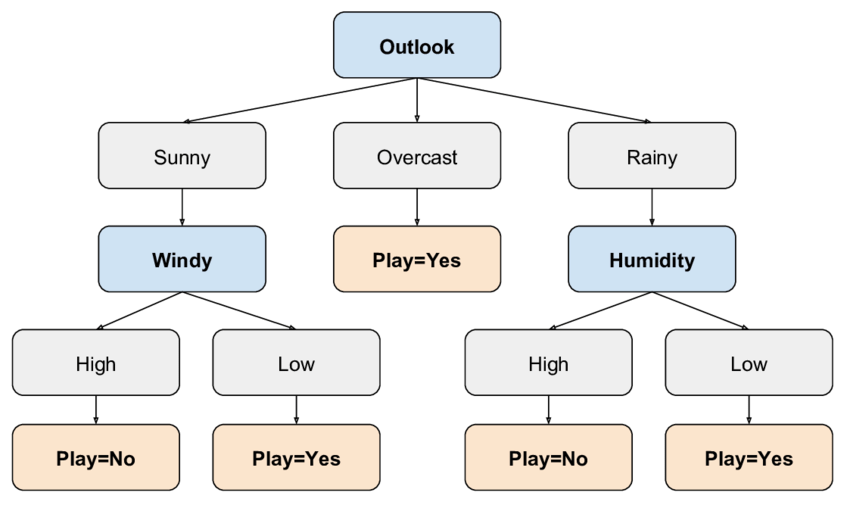
A Decision Tree is a supervised learning algorithm used for both classification and regression tasks. It organizes data into a tree-like structure, where each internal node represents a decision based on a feature, and each leaf node provides a prediction. Decision trees are simple, interpretable, and capable of handling both categorical and numerical data.

Classification Tree

A Classification Tree is a decision tree used for classifying data into distinct categories or classes. The main objective of a classification tree is to predict the category or class to which a given input belongs based on various features.

Read more

About Machine Learning ( Part 3: Logistic Regression )

Classification Problem

In machine learning, when we are predicting a discrete label, such as determining whether an email is spam or not, we are dealing with a classification problem. Logistic regression is commonly used for binary classification tasks, where the goal is to predict one of two classes, typically represented as 0 or 1.

The logistic function (also called the sigmoid function) is the core of logistic regression, as it maps input features to probabilities between 0 and 1. These probabilities represent the likelihood of the sample belonging to a particular class.

The logistic function is defined as:

$$
\sigma(z) = \frac{1}{1 + e^{-z}}
$$

Where $z = \omega_0 + \mathbf{\omega}^T \mathbf{x}$, the linear combination of the input features $\mathbf{x}$ and the model’s parameters $\mathbf{\omega}$.

Read more